By Ayaz Khan · 28 October 2026
Starting a real estate business in Pakistan does not need a big office or crores in capital. Most successful agencies began with one person, a phone and a few trusted projects. What separates the ones that last from the ones that close within a year is usually not the market. It is the basics: the right business model, the registrations the law actually requires, clean records, and a steady way of finding clients.
This guide covers those basics in order: what a real estate business is, which kind to start, how to register it, how to set up your office and records, and how to win your first deals. You will also find practical tips from the way property offices actually work in Pakistan.
Note: This is general information, not legal or tax advice. Fees and rules change, and they differ by province. Confirm current requirements with the offices linked below or with a tax advisor before you register.
What is a real estate business?
A real estate business is any business that earns money from land and buildings: buying, selling, renting, developing or managing property, or helping other people do so. In Pakistan, the most common forms are the local property dealer (estate agent), the real estate marketing company that sells plots for a housing project, and the developer who builds the project itself.
Real estate is usually grouped into five types:
| Type | Examples in Pakistan |
|---|---|
| Residential | Houses, apartments, residential plots in housing societies |
| Commercial | Shops, offices, plazas, commercial plots |
| Industrial | Factories, warehouses, plots in industrial estates |
| Agricultural land | Farmland, orchards, farmhouses |
| Special purpose | Schools, hospitals, hotels, wedding halls |
Most new businesses start with residential plots and houses, because that is where most buyers and transactions are.
مختصر خلاصہ (Urdu summary): ریئل اسٹیٹ بزنس کا مطلب ہے زمین اور جائیداد کی خرید و فروخت، کرایہ، تعمیر یا انتظام سے کمائی کرنا۔ پاکستان میں شروع کرنے کے لیے ایک ماڈل اور ایک علاقہ چنیں، ایف بی آر میں رجسٹریشن کروائیں، پہلے دن سے ریکارڈ رکھیں، اور ایمانداری سے نام بنائیں۔
Step 1: Choose your real estate business model
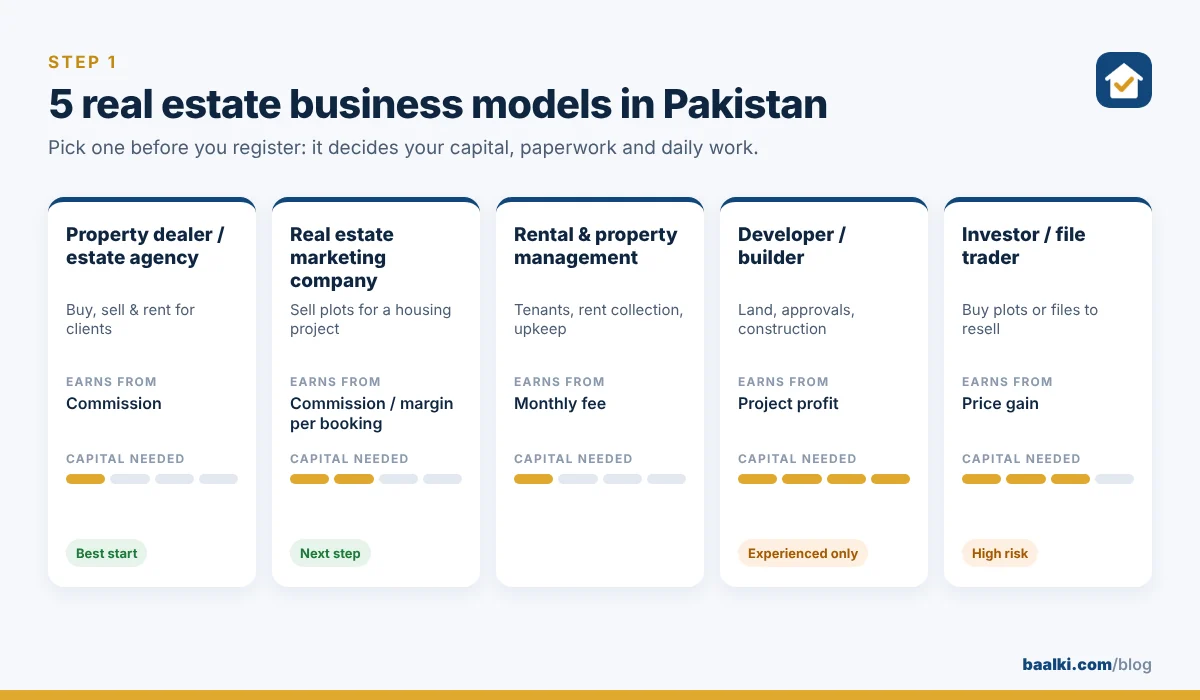
“Real estate business” covers very different jobs. Decide which one you are starting, because it changes your capital, your registrations and your daily work.
| Model | What you do | How you earn | Capital needed | Good for |
|---|---|---|---|---|
| Property dealer / estate agency | Help people buy, sell or rent houses, plots and shops | Commission from buyer and/or seller | Low (office, phone, marketing) | Starting alone in your own area |
| Real estate marketing company | Sell plots or units in a housing society or project on behalf of the developer | Commission or margin per booking, often with inventory targets | Medium (sales team, ads, office) | People with sales teams and developer contacts |
| Rental and property management | Find tenants, collect rent, handle maintenance for owners | Monthly fee or one month’s rent | Low | Cities with many overseas owners |
| Developer / builder | Buy land, get approvals, build and sell | Profit on the project | Very high | Experienced players with land and capital |
| Investor / file trader | Buy plots or files and resell | Price gain | High, and risky | Only with experience and spare capital |
Which is most profitable? Development usually has the highest profit per project, but it also needs the most capital, approvals and time, and carries the most risk. For a beginner, an estate agency or small marketing company gives the best return on the money you put in: low setup cost, income from the first deal, and you learn the market without betting your savings on it.
If you are not sure how commission works in each model, read how real estate commission works for marketing companies in Pakistan.
Starting with little or no money
You cannot buy property without capital, but you can start earning from property without it:
- Join an established agency first as a commission-only agent. You learn deal-making and paperwork, and build your own client list.
- Work one society or one market where you already know people, and list owners’ properties with their written permission.
- Use free channels (WhatsApp, Facebook, a Google Business Profile) before paying for ads or an office.
- Once commissions are steady, register your own business and take a small office.
Step 2: Pick your area and niche
Pakistan’s property market is local. A dealer who knows every street of one area beats a dealer who “does everything” across a city. Before you open, answer three questions:
- Where? One area, scheme or corridor you can cover in person, such as one phase of a housing society or a set of nearby sectors.
- What? Plots, houses, apartments, commercial shops or rentals. Pick one or two to start.
- Who? Local families, overseas Pakistanis, investors or first-time buyers. Each needs different marketing.
Spend two to four weeks visiting the area, meeting existing dealers and the society office, and noting asking prices. This also tells you which projects are genuine and which to avoid.
Tip: Make a simple price sheet for your area: block, plot size, asking price, and the date you heard it. Update it every week. After a month you will know prices better than most people calling you, and buyers notice.
Step 3: Choose a legal structure
You can run a real estate business in Pakistan in four common forms:
| Structure | Registered with | Best when |
|---|---|---|
| Sole proprietorship | FBR only: your personal NTN, with your business name and address added in IRIS | You are starting alone and want the simplest, cheapest setup |
| Partnership (AOP) | Written partnership deed, registered with the Registrar of Firms in your province, plus an NTN for the firm from FBR | Two or more people share investment and profit |
| Limited liability partnership (LLP) | SECP online, plus FBR | Partners who want a registered firm with limited personal liability |
| Single member company (SMC) or private limited | SECP online, plus FBR | You want a separate legal entity, plan to grow, or deal with developers and corporate clients |
Note that SECP registers companies and LLPs only. A sole proprietorship is not registered with SECP; for tax purposes it exists through your NTN.
A company costs more to maintain (annual returns and filings) but looks more serious to developers and keeps business liabilities separate from your personal assets. Many agencies start as a sole proprietorship and convert to an SMC once they grow.
Tip: If you are going into business with a friend or relative, write the partnership deed before the first deal: who invests what, how profit and commission are split, and what happens if one partner leaves. Most partnership fights in property are about money nobody wrote down.
Step 4: Register your business (the part most guides skip)
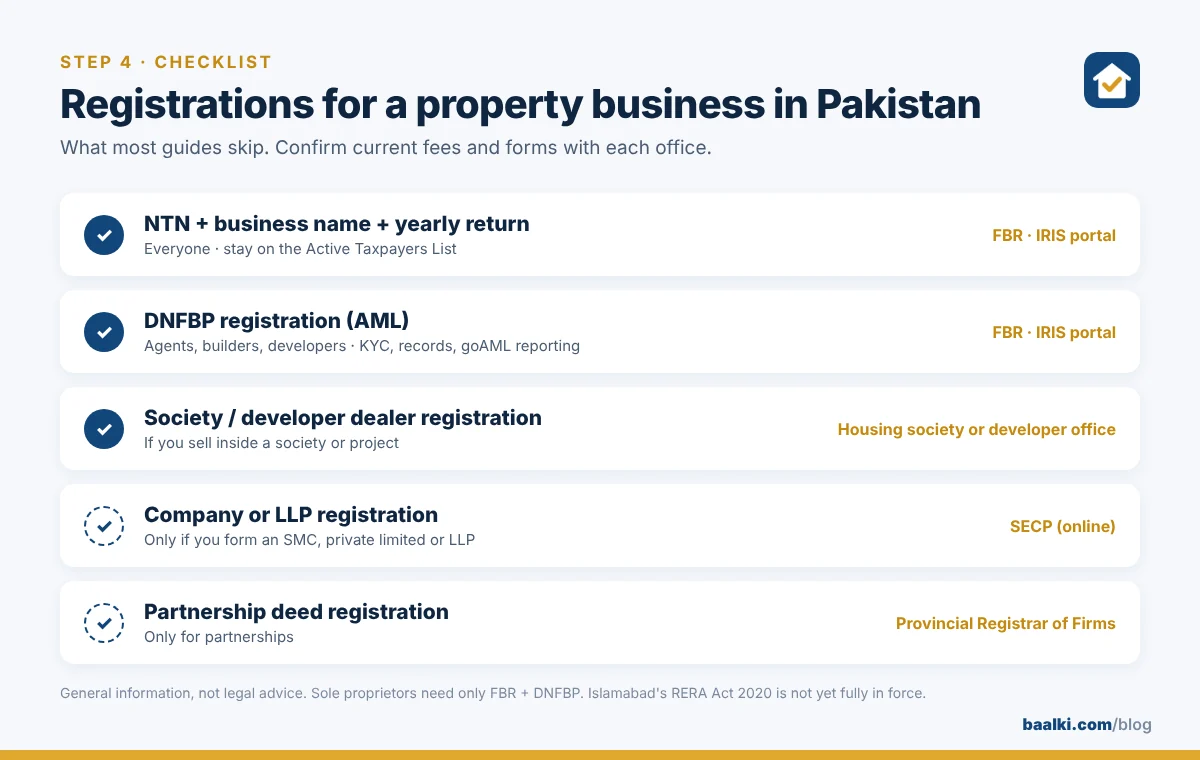
Most articles stop at “get an NTN”. In practice, a property business in Pakistan usually needs the registrations below.
4.1 FBR registration (NTN) and tax filing
Register with the Federal Board of Revenue through IRIS to get your NTN, add your business name and office address, and file your income tax return every year. Being on the Active Taxpayers List matters in property work, because withholding tax on property transactions is higher for non-filers, and clients increasingly ask about it. Commission income is taxable, so keep proof of every commission you receive.
4.2 SECP or Registrar of Firms (only if you are not a sole proprietor)
If you chose a company (SMC or private limited) or an LLP in Step 3, register it online with SECP first, then get the company’s NTN from FBR. For an ordinary partnership, register the partnership deed with your provincial Registrar of Firms. Developers and banks will usually ask for these documents before they sign you up as a dealer or open a business account.
4.3 DNFBP registration with FBR (anti-money laundering)
Real estate agents, builders and developers are treated as Designated Non-Financial Businesses and Professions (DNFBPs) under the Anti-Money Laundering Act, 2010, supervised by FBR. In 2022, FBR said real estate agents should not deal in property unless registered as a DNFBP and holding a registration certificate.
In practice, DNFBP duties include:
- Knowing your customer: checking and keeping copies of the CNIC/NICOP of buyers and sellers.
- Keeping records of identity and transactions for several years.
- Reporting suspicious or large cash transactions to the Financial Monitoring Unit through its goAML system.
Registration is done through IRIS. Check the latest FBR DNFBP guidance for current thresholds and forms.
4.4 Housing society or developer dealer registration
Many housing societies and developers keep their own list of registered or authorised dealers, and some only accept bookings or transfers through them. Ask at the society office what they need, usually your CNIC, NTN, office address and a fee.
4.5 Islamabad: watch the RERA Act
Islamabad passed the Real Estate (Regulation and Development) Act in 2020, which requires real estate agents to register with a Real Estate Regulatory Authority and quote their registration number in every deal (summary by IIPS). However, as Dawn reported in April 2026, the authority has still not been fully set up, and the government is considering changes to the law. If you work in Islamabad, check the current position with the CDA and ICT administration before you start.
Good to know: On paper, the provinces still have a 1980 law, the Real Estate Agents and Motor Vehicles Dealers (Regulation of Business) Ordinance, which is handled by the Excise and Taxation department (see the KP rules made under it). In practice today, the Excise department deals mainly with vehicle registration and property dealers are rarely asked to register there, so it is not a standard step. If a local office does ask, that is the law it refers to.
Registration checklist
| Registration | Office | Needed by |
|---|---|---|
| NTN, business name and annual tax return | FBR (IRIS) | Everyone |
| DNFBP registration | FBR (IRIS) | Real estate agents, builders, developers |
| Company or LLP registration | SECP | Companies and LLPs only |
| Partnership deed registration | Provincial Registrar of Firms | Partnerships only |
| Society / project dealer registration | The housing society or developer you sell for | Agents selling in that society |
The last row is easy to forget, and in many societies it decides whether you can sell there at all.
Step 5: Set up your office
You do not need a large office, but you do need a fixed, visible place of business. It goes on your FBR record and your society registration, and buyers trust a dealer they can find again.
A practical starting setup:
- A small office or shop near the area you cover, with a clear signboard
- A business mobile number on WhatsApp Business, with a catalogue of current listings and quick replies for common questions
- Printed formats: plot booking form, payment receipts, token (bayana) receipts, and authority letters from owners
- A Google Business Profile so people searching “property dealer near me” find you on Maps
- A Facebook page (and Zameen or Graana listings if your budget allows)
Tip: Use WhatsApp Business labels (New lead, Site visit done, Negotiating, Booked) from day one. It is free, and it turns your chat list into a basic sales pipeline.
Step 6: Set up records from day one
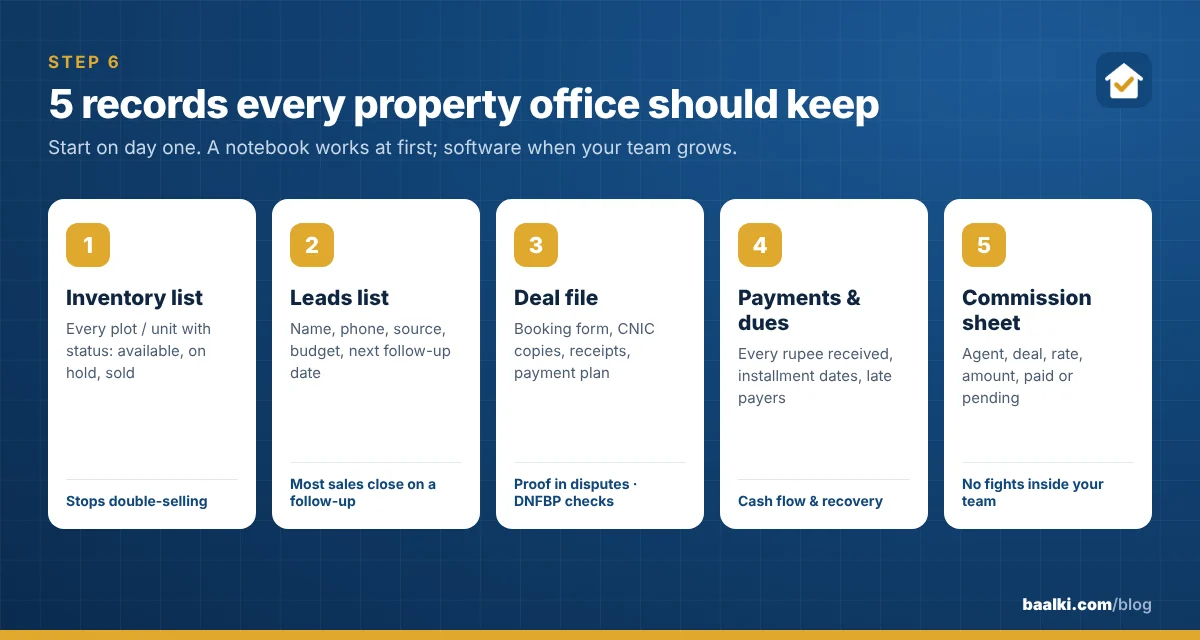
This is where most new property businesses lose money. Deals are agreed on WhatsApp, payments are taken in cash, and the details live in one person’s head. Six months later, nobody can say which plot was promised to whom, who paid the token, or how much commission is owed to which agent.
FBR’s DNFBP rules already expect you to keep identity and transaction records, and every dispute is settled by whoever has the paperwork. Build that habit from the first deal.
| Record | What to keep | Why it matters |
|---|---|---|
| Inventory list | Every plot, house or unit you are selling: location, size, price, status (available / on hold / sold) | Stops two agents selling the same plot |
| Client / lead list | Name, phone, source (Facebook, walk-in, referral), budget, next follow-up date | Most sales come from the second or third follow-up |
| Deal file | Booking form, CNIC copies, receipts, payment plan, transfer documents | Proof if a dispute arises; needed for DNFBP checks |
| Payments and dues | Every amount received, installment dates, late payments | Cash flow and recovery |
| Commission sheet | Agent, deal, rate, amount, paid / pending | Avoids fights within your own team |
You can start with a notebook and a spreadsheet. Once you have more than a few agents or a project with many plots, software that keeps inventory, leads, bookings, payments and commissions in one place saves real time. That is the job real estate ERP software does.
Before taking a booking for any project, also learn how to check whether a plot file is genuine. Selling for an unapproved scheme can destroy your reputation in one season.
Step 7: Get your first clients
New agencies usually get their first deals from people they already know. After that, the steady channels in Pakistan are:
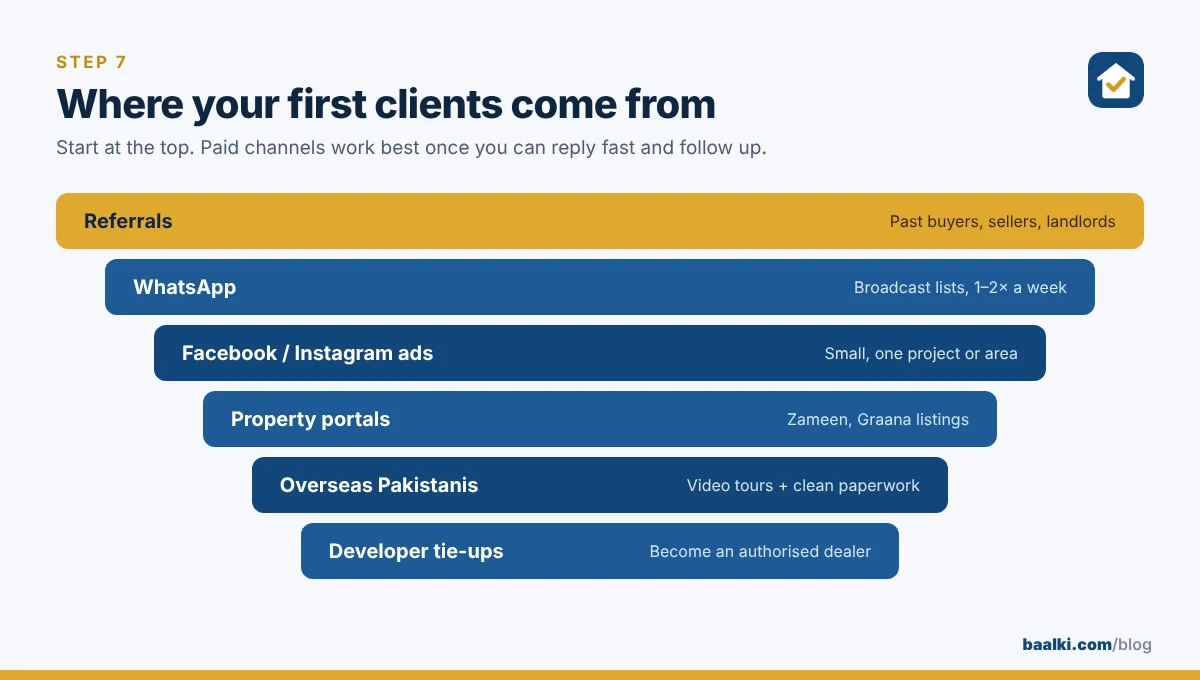
- Referrals: ask every satisfied buyer, seller and landlord to recommend you, and keep in touch after the deal (a message on Eid goes a long way).
- WhatsApp: broadcast lists of current listings, sent once or twice a week, not daily.
- Facebook and Instagram ads: small, targeted ads for one project or area, with a WhatsApp button. Respond within minutes, not hours.
- Property portals: listings on Zameen, Graana and similar sites bring buyers who are already searching.
- Overseas Pakistanis: they need someone trustworthy on the ground. Video tours, clear paperwork and regular updates win them over.
- Developer tie-ups: once you have a small team, approach housing projects to become an authorised dealer or marketing partner.
For a deeper look at turning ad clicks into bookings, read real estate leads in Pakistan: from Facebook ad to booking.
Step 8: Build trust and grow
In Pakistani real estate, reputation is the business. When you grow from one person to a team of five or ten, the biggest risks shift from finding clients to managing them: double bookings, lost leads, unpaid installments and commission disputes. That is when it is worth moving from spreadsheets to proper real estate software.
Hire slowly. Add agents once you have more leads than you can handle, agree their commission split in writing, and make sure every lead and deal is recorded in the office system, not only on the agent’s own phone.
8 practical tips for a property business that lasts
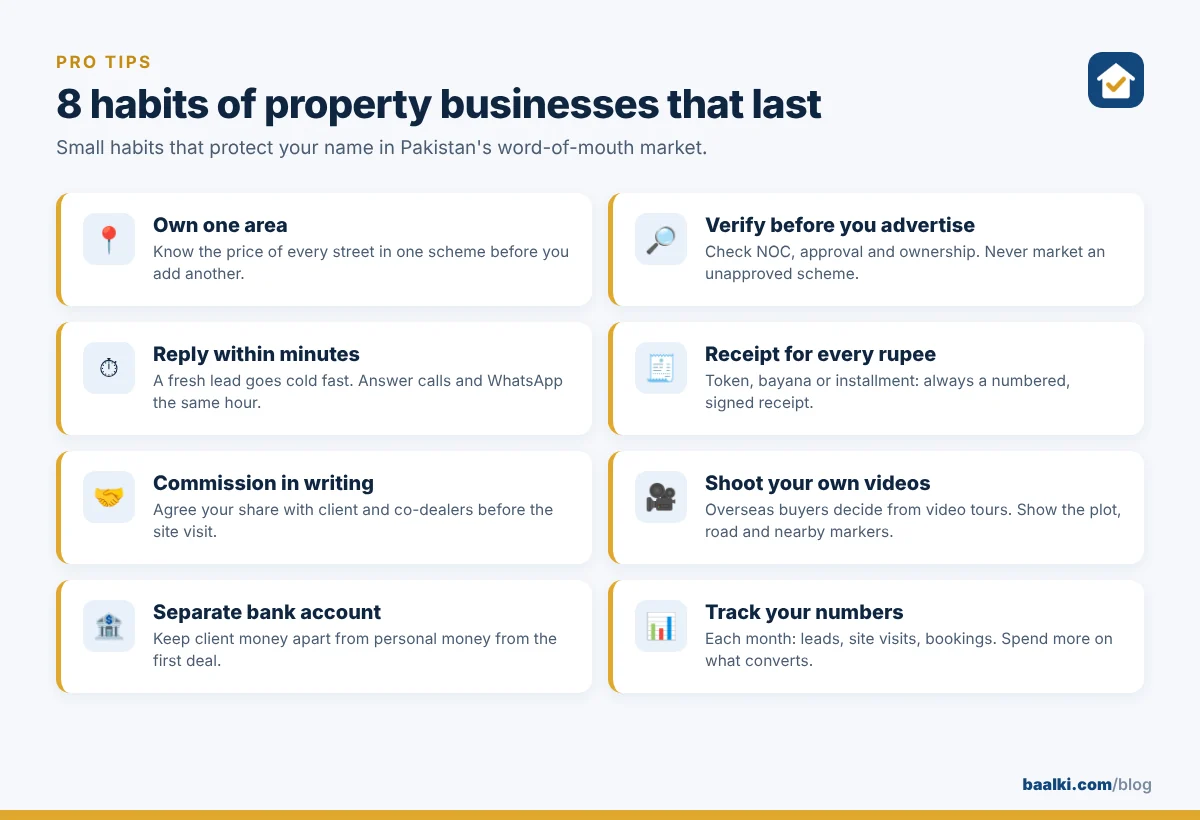
- Own one area before you add another. Know the price of every street, the society’s rules and the transfer process in one scheme. Depth beats coverage.
- Verify before you advertise. Check the scheme’s approval or NOC with the relevant development authority, and the seller’s ownership documents, before you post a single ad.
- Reply within minutes. A buyer who fills a form or sends a WhatsApp message is usually contacting several dealers. The first one to give a useful answer often gets the visit.
- A receipt for every rupee. Token, bayana or installment: always a numbered, signed receipt with the plot number and the refund condition written on it.
- Agree commission in writing. Settle your share with the client, and with any co-dealer, before the site visit, not at the time of transfer.
- Shoot your own videos. A two-minute phone video showing the plot, the road, nearby landmarks and the society gate does more for an overseas buyer than any brochure.
- Keep a separate business bank account. Never mix client money with personal money. It protects you in disputes and makes tax filing and DNFBP checks easier.
- Track your numbers every month. Count leads, site visits and bookings by source. If Facebook brings 100 leads and two bookings while referrals bring 10 leads and three bookings, you know where to spend.
Common mistakes to avoid
- Starting without registration, then struggling when a developer or bank asks for your NTN or company documents
- Selling files of unapproved housing schemes because the commission is high
- Taking cash without receipts, or using personal accounts for client money
- Promising prices or possession dates you cannot control
- Covering too many areas and knowing none of them well
- Keeping all records on one phone, so the business stops when that person leaves
Frequently asked questions
Is real estate a good business in Pakistan?
It can be. Property remains one of the main ways Pakistanis save and invest, so there is steady demand for honest agents, especially among overseas Pakistanis and first-time buyers. Profit depends on your area, your contacts and how well you run the business, and the market slows down when taxes or interest rates rise.
What is the most profitable real estate business?
Property development usually has the highest profit per project, but it needs large capital, approvals and years of work, and carries the most risk. For most people starting out, an estate agency or real estate marketing company gives the best return on the money invested.
How much money do I need to start a real estate business in Pakistan?
As an estate agent or small agency, your main costs are office rent, registration fees, marketing and your own living expenses for the first few months until commissions start. Development and file trading need far more capital. Make a simple budget for six months of costs before you start.
Can I start a real estate business without money?
Yes, as an agent. Many people start as commission-only agents with an established agency, or by marketing properties for owners they know, using free channels like WhatsApp and Facebook. Buying or developing property, however, always needs capital.
Do I need a license to become a property dealer in Pakistan?
There is no single national property dealer license that everyone gets today. In practice you need an NTN from FBR, DNFBP registration with FBR, and registration with any housing society or developer you sell for. Companies and LLPs also register with SECP. In Islamabad, the RERA Act 2020 will require agent registration once its authority is fully set up.
Is real estate business halal?
Most Islamic scholars consider buying, selling, renting and brokering property permissible in principle, as long as the dealing is honest: no hiding defects, no selling what the seller does not own, clearly agreed prices and commission, and no interest-based arrangements. For a specific transaction or financing structure, ask a qualified scholar or an Islamic finance expert.
Can I start a real estate business online?
You can do most of your marketing online through social media, WhatsApp and property portals. However, you still need registration and a fixed place of business, and most buyers in Pakistan want to meet you and see the property before paying.
What is the difference between a property dealer and a real estate marketing company?
A property dealer helps individual buyers, sellers and tenants with existing properties. A real estate marketing company sells plots or units in a particular project on behalf of its developer, usually with a larger sales team and inventory targets.
Conclusion
Starting a real estate business in Pakistan is less about capital and more about doing the basics well: choose one model and one area, register with FBR (and SECP if you form a company), keep clean records from the first deal, and build your name through honest dealing. Get those right, and growing from one desk to a full sales team becomes much easier.
Running a growing agency or marketing company? Baalki keeps your plot inventory, leads, bookings, payments and commissions in one place, so your team never double-sells a plot or loses a lead. Book a free demo to see how it works.